

Introduction
In today’s competitive digital economy, businesses cannot rely only on intuition or past experience to make important decisions. The rise of big data, analytics tools, and artificial intelligence has completely transformed how organizations operate. Data-driven decision making for business means using facts, metrics, and data analysis to guide strategic, operational, and tactical decisions instead of guessing or relying only on gut feeling. Companies that adopt this approach gain a strong competitive advantage because they can understand customer behavior, predict market trends, reduce risks, and optimize performance more effectively. In simple terms, data becomes the foundation of smarter business choices, leading to better outcomes and sustainable growth.
1. Understanding Data-Driven Decision Making in Business
Data-driven decision making (DDDM) is the process of collecting relevant data, analyzing it, and using insights to guide business actions. It involves structured thinking and evidence-based strategies rather than assumptions. Businesses collect data from multiple sources such as customer interactions, website analytics, sales records, social media platforms, and market research reports.
The goal is not just to collect data but to turn it into meaningful insights. For example, a retail company may analyze customer purchase patterns to decide which products to stock more frequently. Similarly, an online business may study website traffic data to improve user experience and increase conversions.
Modern organizations use tools like dashboards, CRM systems, and analytics platforms to visualize and interpret data. This helps decision-makers understand complex patterns quickly and act confidently.
2. Importance of Data-Driven Decision Making for Business Growth
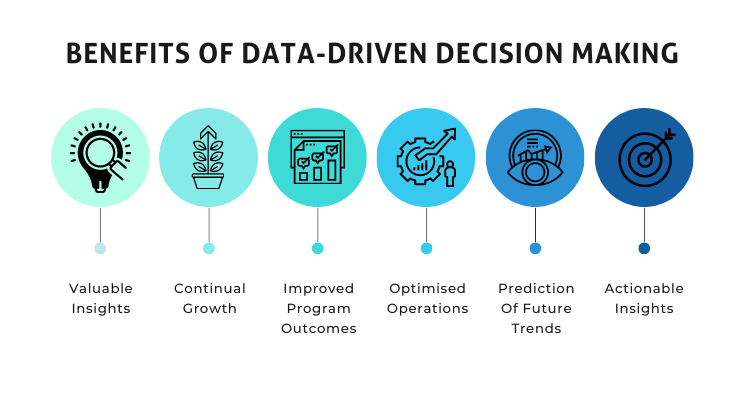
Data-driven decision making plays a crucial role in business success because it reduces uncertainty and improves accuracy. When decisions are based on real evidence, companies are less likely to make costly mistakes.
One major benefit is improved efficiency. Businesses can identify what is working and what is not, allowing them to optimize resources. For example, marketing teams can focus only on high-performing campaigns instead of wasting money on ineffective ads.
Another important benefit is better customer understanding. Data reveals customer preferences, buying behavior, and pain points. This allows businesses to create personalized experiences, which increases customer satisfaction and loyalty.
Additionally, data-driven strategies help in risk management. By analyzing historical trends and market conditions, companies can predict potential challenges and prepare in advance. This proactive approach significantly reduces financial and operational risks.
3. Key Tools and Technologies Used in Data-Driven Decision Making
Modern businesses rely on various tools and technologies to implement data-driven decision making effectively. These tools help in collecting, processing, and analyzing large volumes of data.
Business Intelligence (BI) tools such as dashboards and reporting systems allow companies to visualize data in an easy-to-understand format. These tools provide real-time insights that help managers make quick decisions.
Customer Relationship Management (CRM) systems store valuable customer data, including purchase history, communication records, and preferences. This data is essential for improving customer service and sales strategies.
Big data analytics platforms process large and complex datasets to find patterns and trends that are not visible through traditional methods. These platforms are especially useful for large enterprises dealing with massive amounts of information.
Artificial intelligence and machine learning tools are also becoming increasingly important. They help businesses predict future outcomes based on historical data, enabling smarter forecasting and automation of decision-making processes.
4. Steps to Implement Data-Driven Decision Making in a Business
Implementing data-driven decision making requires a structured approach. The first step is identifying clear business goals. Without a clear objective, data collection becomes meaningless. Businesses must define what they want to achieve, such as increasing sales, improving customer retention, or reducing costs.
The second step is data collection. Organizations must gather relevant and high-quality data from reliable sources. Poor-quality data can lead to incorrect conclusions, so accuracy is very important.
The third step is data analysis. This involves using analytical tools and techniques to interpret the collected data. Businesses look for patterns, trends, and correlations that provide meaningful insights.
The fourth step is decision-making based on insights. At this stage, managers use analyzed data to make informed business choices. These decisions are more accurate and reliable compared to guesswork.
The final step is monitoring and optimization. After implementing decisions, businesses must track performance and measure results. If needed, strategies should be adjusted based on new data to ensure continuous improvement.
5. Challenges in Data-Driven Decision Making for Business
Although data-driven decision making offers many advantages, it also comes with challenges. One of the biggest challenges is data quality. If the data is incomplete, outdated, or inaccurate, it can lead to wrong decisions.
Another challenge is data overload. Many businesses collect too much data without knowing how to use it effectively. This can create confusion and slow down decision-making processes.
Lack of skilled professionals is also a major issue. Data analysis requires expertise in statistics, analytics tools, and interpretation skills. Without trained staff, businesses may struggle to extract meaningful insights.
Data privacy and security concerns are another important challenge. Businesses must ensure that customer data is protected and used ethically. Any breach of trust can damage reputation and lead to legal issues.
Finally, resistance to change can also slow down adoption. Some organizations still rely on traditional decision-making methods and may hesitate to shift toward a data-driven culture.
Conclusion
Data-driven decision making for business is no longer optional; it is essential for survival in today’s fast-paced digital world. Companies that use data effectively can improve efficiency, understand customers better, reduce risks, and achieve long-term success. Although there are challenges in implementation, the benefits far outweigh the difficulties. By adopting the right tools, strategies, and mindset, any business can transform its decision-making process and achieve sustainable growth.
FAQs
Q1: What is data-driven decision making in business?
It is the process of using data analysis and insights instead of intuition to make business decisions.
Q2: Why is data important for business decisions?
Data helps businesses make accurate, informed, and risk-free decisions based on real facts.
Q3: What tools are used in data-driven decision making?
Common tools include BI dashboards, CRM systems, Google Analytics, and AI-based analytics platforms.
Q4: What are the benefits of data-driven decision making?
It improves efficiency, reduces risks, enhances customer experience, and increases profitability.
Q5: What is the biggest challenge in using data for decisions?
The biggest challenge is ensuring data quality and having skilled professionals to analyze it effectively.
